LIGHTNING and its effects
The users or electronic equipment, telephone and data-processing systems must face the problem of keeping this equipment in operation spite of transient overvoltages induced by lightning.
There are several reasons:
- Intégration of electronic components makes the equipment more vulnerable.
- Interruptions of service are unacceptable
- Data transmission networks cover large areas and are exposed to more disturbances
Lightning
Investigated since Benjamin Franklin's first research in 1749, lightning has paradoxically become a
growing threat to our highly electronic society. Lightning is a natural phenomenon, defined as electrical shock between two zones of opposite polarity, between the cloud and the ground. The result is a current lasting some tenths of microseconds which will generate side effects, transient overvoltages, which are much more destructive than the discharge itself. The development and the increasing complexity of electronic or computing equipment entail a bigger sensitivity with surges.
The lightning constitutes a real threat for companies’ equipment but also for independent profession or even private individuals. Against lightning itself, the protection technique consists in capturing the discharge to divert it from its initial target, safely to earth.
The lightning will be attracted to the 'lightning conductor' or the “meshed cage' and will save the site, however your electronic equipment will not be protected against the side effects..
Direct effects
At the moment of the discharge, there is an impulse current flow that ranges from 1,000 to 200,000 Ampere peak, with a rise time of about few microseconds. This direct effect may be considered as a small factor in damaging electric and electronic systems, because it is highly localized.
The best protection is still the classic lightning rod or Lightning Protection System (LPS), designed to capture the discharge current and conduct it to a particular point.
Indirect effects
The flash may travel several miles, advancing toward the ground in successive leaps: the leader creates a highly ionized channel. When it reaches the ground, the real flash or return stroke takesplace. A current in the tens of thousands of Amperes will then travel from ground to cloud or vice versa via the ionized channel.
We should consider that lightning strikes to the ground up to 1km away can induce transient overvoltages into the electrical systems of structures, so the likelihood of transient overvoltages from this source are much higher than that from a direct lightning strike, due to the much larger collection area.
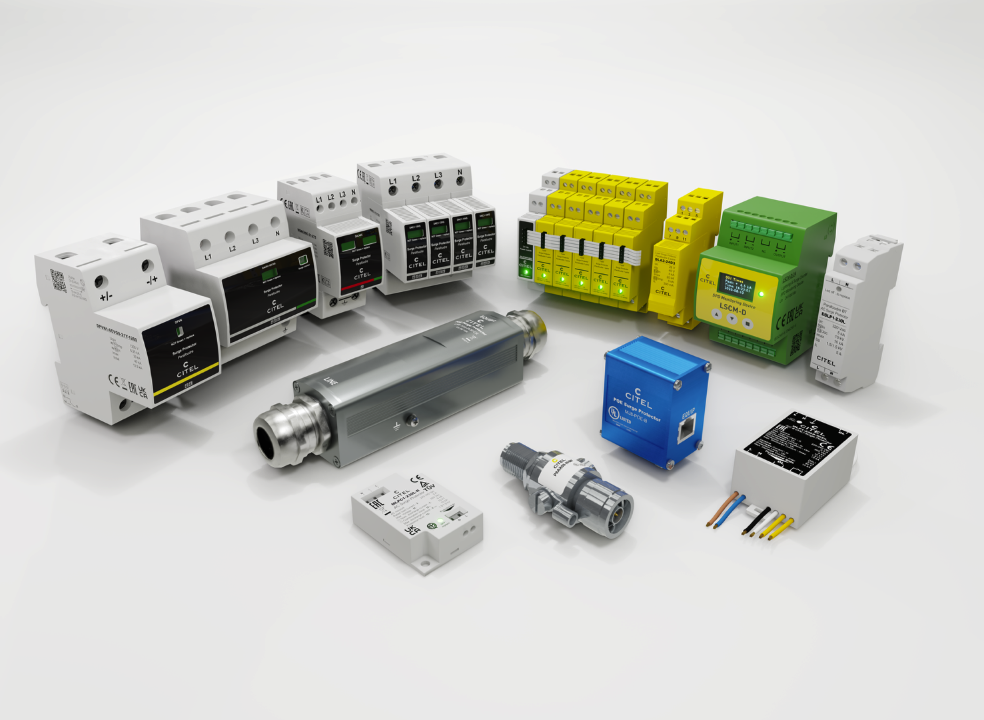
The way to protect against the indirect effects of lightning is to use surge protectors